[This post was originally made back in September of last year, after a family Summer holiday in North Norfolk, see part 1.]
This is a sort of “soft launch” of something I’ve hinted I’ve been working on for BRP previously.
So I took my laptop with me, mainly to game/stream in the evening, but also to do some writing if the family allowed it – which they did, now that everyone is hooked to their phones/devices! I made a deal with myself that I was only going to do fun RPG writing, rather than stuff that is “get it damn well finished!” :
Previously, when I last had a holiday during Easter break, I had a good tinker with the BRP-ORC SRD (aka the entire text of Basic Roleplaying Universal Game Engine). The aim was to get a straightforward Fantasy-BRP game out it. Well, I’ve been fiddling with the embryonic game that emerged from those writing sessions on and off. Despite my reservations, it started shipping up to something I enjoy writing. So this became a light, fun project over my recent family holiday in North Norfolk. I got up early and got set for the day (ie. did my dad duties around the cottage), and then while the family had a sleep in I would work on the document. Go out for the day, and once everyone had settled for the evening, write up whatever my brain had come up with in the background during the day.
My design process has been roughly the following for the game, which has the working title Legacy.

1. Take the base of RuneQuest 3 – which, minus the three Gloranthan magic systems is in BRUGE – much to my delight, and bash it into the same length and scope as the old Games Workshop core RQ3 book, which was my first serious entry point into BRP back in the late 80s. In fact here its.
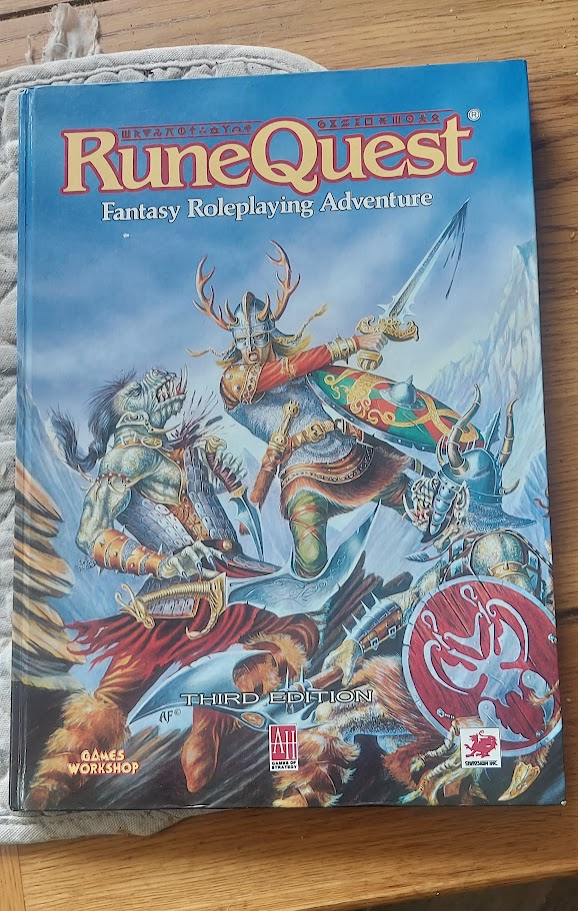
Note that Legacy is not an RQ clone, despite the SRD it developed from having much of the text. It’s more of a what-if project: “What if we take core RQ3 and develop it so it’s easier to play and supports sandbox-style play out of the box?”
2. Make character generation fun. It’s now a seven-step process, with a final eighth step that gets the players to consider how their characters met and formed their adventuring company. Skills remain the focus, and players gain them through from the following sources.
- Personality Type. Expanded to include two new ones, so all the characteristics except SIZ, have one associated with them
- Profession of which there are five groupings: Magician, Rogue, Rural, Urban, Warrior each with five professions, so a total of 30 FUN fantasy professions, like Knight, Oracle, Occultist etc
- A free choice of a hundred Free skill points.
Equipment is picked up from that listed under the profession, and everyone gets a Family Heirloom, a minor magical item with its own Wyrd.
3. Every character is a champion with a Wyrd (or destiny). This sets the character out from the stay-at-home folks, and in-game terms allows rerolls and bonuses to various rolls upon spending Wyrd Points. It’s a modernising touch, and one that should make the characters more epic than their Old School BRP ancestors.
4. Only Magicians have magic. The Magic chapter is but one, alongside Combat, and there is one magic system (BRUGE’s Magic, more or less as is, with enough extra spells to support the game’s five Magician Professions)
5. Streamline systems while still keeping it BRP. So gone is the Resistance table, and resistance rolls are now a subset of characteristic rolls modified by difficulty. So for example a POT 20 poison vs a character with CON 15 would be a Difficult Stamina roll to resist. I’ve also standardised the criticals and specials chance table into a much shorter table where they are listed by competency.
6. Fun Combat. Yes, hit locations are back because I miss them from my 90s RQ3 days (and remember, BRUGE is a lot of RQ3). As is the DEX initiative model of BRP inherited from early editions of Call of Cthulhu is one I know works for me. Not that hated strike ranks are available via BRUGE – because that would allow people to make RQ clones. All the fumble tables have been condensed into one and all those wacky roll again once/twice/three times results that get oh so boring in play have new results. Also the “you hit nearest friend” results. Because no one really wants that :). Overall aim is to make BRP combat as quick and smooth as I’ve done with OpenQuest but without gutting what people see as BRP (so specials are still there)
7, Sandbox adventure creation. Don’t get me wrong, I love the guided scene-by-scene or location-based adventures I write for OpenQuest, but there’s time when I wish I could just turn up for game night with a page of bullet points, all the important monsters statted up, and a couple of random tables to support improvised play. So, this is the route I’m taking here.
8. There is an implied setting, The Realm. This is the character’s civilisation surrounded on all sides by hostile borderlands, beyond which are hostile nations and even wilderness ravaged by the Warp, an chaotic mutating power that occasionally intrudes into reality, leaving destruction in its wake. The players and the GM discover and fill out details during play. Guidance on how is currently earmarked to go in the unwritten GM’s Guidance chapter and peppered throughout the rules.
Lastly, I kept the following two questions and answers in mind while hacking away at the rules.
Does this mean I’m throwing OpenQuest or Sky Pirates under the bus? Heck no, I love OQ and have fun playing it regularly on OpenQuest Thursday game nights, during my regular Empire of Gatan campaign. Sky Pirates is still happening. Most of it is written but may be pipped to the post by Legacy, simply because I’ve already happily got the art for it.
Ultimately, why am I doing this? This scratches a different itch of D100 gaming. The need as a longtime BRP fan to have a quick plug-and-play version of Fantasy BRP, based on my nostalgia for my very early experiences with RQ3 before it got cluttered and frankly very confused with all the options in the Advanced RQ3 book that Games Workshop brought out a couple of months after the core book. Where I just drew a map, made up a few monsters, called some mates round who quickly generated characters, and boom had a series of happy afternoons of carefree adventuring with no grand meta-plot lurking in the background. BRP unleashed and supported the players’ creativity, used to the restraints of D&D.
Update: the above was a snapshot of where I was with Legacy in September 2024. I put it to one side once my holidays ended and didn’t pick it up again until Christmas. Since then I have steadily been working on it on and off since then. It’s now at the point where it’s being internally playtested, has a logo courtesy of Dan Barker, and is being polished up for a public playtest, possibly leading into a Kickstarter in early summer. However, my internal playtest has thrown up many changes. The biggest one is a complete rewrite of the game’s magic system, making it more flexible and, dare I say it, free-form, yet still familiar to old hands. I know that’s a big aim, but that’s where I’m going with it. Overall, the game is rapidly evolving into its own thing, without ceasing to be BRP. I’m playing OpenQuest online in the same week-cycle as my Legacy playtest, and while they both share the same roll under D100 skill mechanic, they are very different games, which is very satisfying. I’ll post a more formal announcement when the game goes into public playtest.

 Sorcerer Under Mountain