So the Bleak Season is here, and my jolly Summer of Oldhammer becomes a Winter thing. I’m skipping my rather self-indulgent part one, “Warhammer and Me”, and getting straight into looking at the first edition of Warhammer.
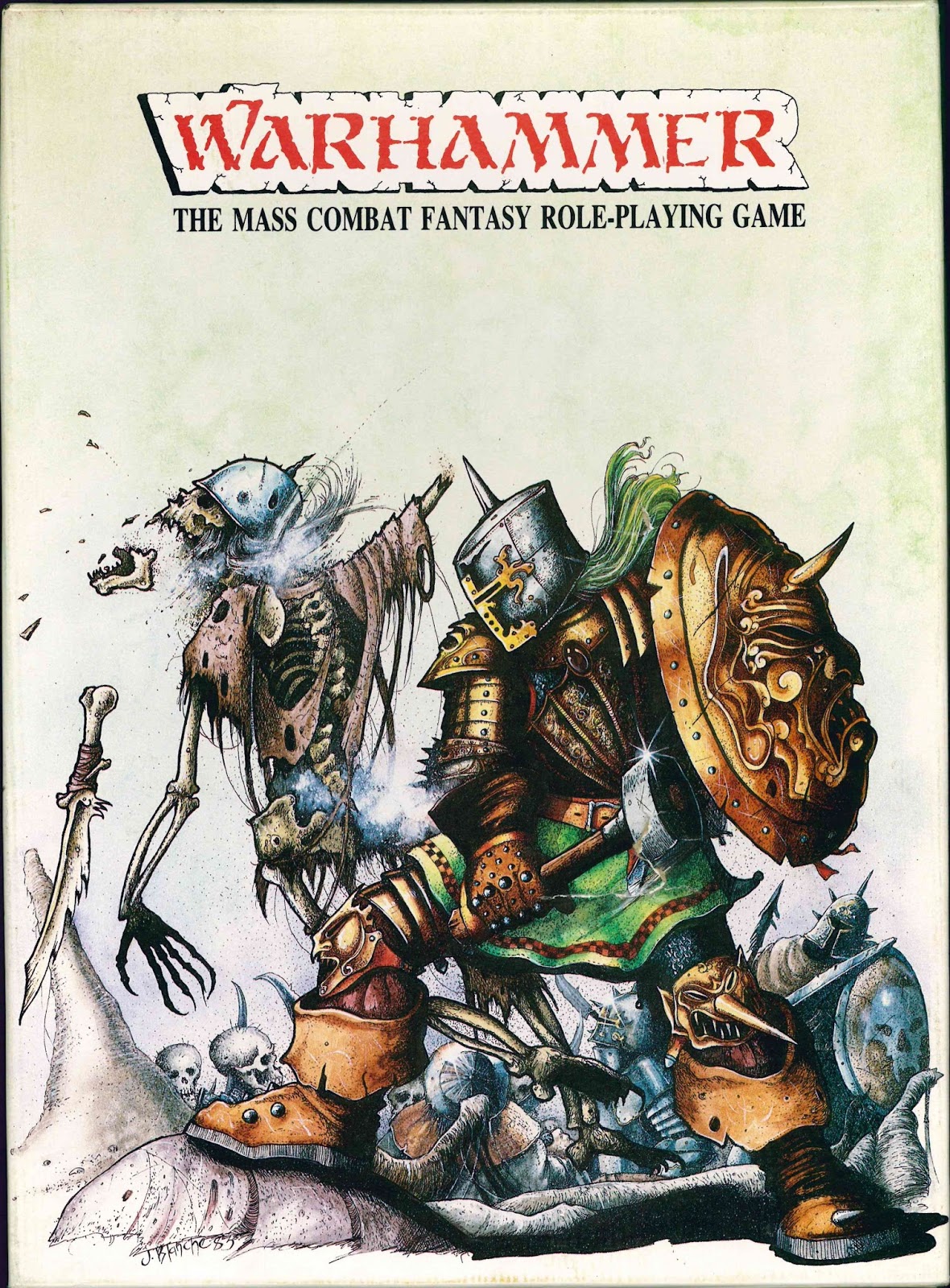
I first came across the game in 1986, a good three years or so after Games Workshop released it. Myself and my mate Kevin spent a good hour staring at it, trying to work out what it is was. Was it a wargame or was it a roleplaying game. It was already out of print, in fact Warhammer Battle (2nd Edition) had been released the year before. Kev had swapped it with an older boy, who had thought it was a proper RPG, along with Warhammer Fantasy Batlte, Fantasy Forces (a box of supplements, more on that later) and a starting miniatures collection – which I still have to this day because Kevin always the entrepreneur sold it all on to me since I was interested, but cannily kept the Warhammer 1st Box sensing it would be worth something in the future. He was right, complete boxes go for £100+ on eBay, with individual books going for £40+.
Contents of the White Box
Book 1 Tabletop Battles (softcover, B&W illustrations throughout, pages 50). This is the core rule book with everything you need to know to run the game as a miniatures wargame. It contains Warhammer’s distinctive psychology system, a short bestiary with the iconic Warhammer take on the usual suspects from Western myth, legend and folklore, and the quick scenario of the Ziggurat of Doom.
Book 2 Magic (softcover, B&W illustrations throughout, pages 38). The complete magic system. Wizards and Necromancers, enchanted items and random generation of spell casters for the wargame.
Book 3 Characters (softcover, B&W illustrations throughout, pages 34). This is the companion Roleplaying rules. They add a simple extra layer of rules effectively allowing the player characters who are champions and leaders of units. There are character generation rules, characters having special abilities (in a very basic form compared to WFRP), advancing through experience, random adventure encounters, guidance for creating adventures and the starting adventure/mini-campaign Redwake River Valley.
My takeaways.
Overall this is the UK’s White Box RPG, comparable to the 70s Original Dungeons and Dragons set. It’s recognisably Warhammer in an embryonic form. Some elements will thrive and grow, and some will with and die as we progress, even through the quick succession of editions during the 80s.
Primitive layout and art. The distinct infamous “chaos-spikey” bits style is already in place, and there are pieces that are so iconic they will be reused even in Warhammer Fantasy Roleplay years later.
RPGing elements are minimal. There is no cosy GMs guide or “how to play your character” or even copious examples. It’s assumed that you know what you are doing or can quickly work it out from reading the procedural rules. But there’s a big seed of excitement here: you can quickly switch between playing a roleplaying game and, say, playing out a climatic battle as a full-blown wargame. Think The Hobbit, which every UK fantasy fan at the time had read at school. You roleplay the the journey to the Loney Mountain, perhaps fighting Smag the Dragon (or like the book, having the GM fudge it because your characters are too low level) when you get there, and fighting The Battle of Five Armies as a full tabletop wargame as a big finale. Oh the dream!
It has a very broad brush strokes setting, the Old World isn’t even mentioned ye, and while it’s implied, it seems to be assumed that you’ll make your own world up.
If memory serves me correctly, Games Workshop’s Design Studio quickly threw together Warhammer 1st Editon in response to the company merging with Citadel Miniatures. As designer Rick Priestly put it, “we were now selling miniatures, so we needed a set of wargaming rules to go with it.” The roleplaying in Book 3 was almost an afterthought. This will have a big effect on the game’s scope in the future.
Next, the Warhammer 1st edition supplements Forces of Fantasy and the Book of Battalions.
 Sorcerer Under Mountain